If there is one thing most baseball fans can agree on, it’s their passionate hate for the New York Yankees. Why? Well, as one Phillies fan puts it, “they buy their way into championships”.
Large market teams such as the Yankees, Boston Red Sox, and Los Angeles Angels have the financial power to sign expensive free agents, over small market teams such as the Milwaukee Brewers. In fact, the Brewers contract offer of four years and $100 million to this year’s top free agent, CC Sabathia, was dwarfed by the Yankees offer of six years and $140 million.
The financial authority that large market teams have over small market teams is why baseball fans want a salary cap. A salary cap is simply a limit on how much a team can spend on their roster payroll. By implementing a cap, fans feel that a competitive balance will be restored to baseball since large markets teams will no longer be able to outspend small market teams on pricy free agents.
However, success is not directly tied to payroll. In 2008, of the teams with the ten highest payrolls, only five made the playoffs. In fact, the league’s three highest payroll teams did not even make even make the playoffs. The Tampa Bay Rays, the American League champions and World Series participant, had the second lowest payroll at just over $43 million. Competitive balance in baseball is fine and the belief that teams with money have a competitive advantage is a fallacy.
With a cap, small market teams would still not spend. Just because large market teams will be restricted, there will still be no incentive for the owners of small market teams to spend. Meanwhile, a cap would unfairly punish successful and organized franchises. Also, while large market teams can spend more money on their payroll, to be successful, they still need to spend it wisely. Spending money on just anybody is not smart business and can hurt teams. Before the 2007 season, the San Francisco Giants signed pitcher Barry Zito to a seven year and $126 million dollar contract, the largest ever for a pitcher at the time. Since then, Zito has been one of the worst starters in baseball and his contract has hurt the Giants.
Major League Baseball’s solution to the “problem” was revenue sharing. Under the current contract, all teams must pay out 31% of their local revenue and it is split evenly among all thirty teams. Also, MLB’s Central Fund is divided up among teams according to their revenue. In affect, revenue sharing is basically the transition of money from large market teams to small market teams.
The current revenue sharing system has its own problems. Again, owners of small market teams have no incentive to re-invest the money they receive from large market teams on their payroll. This is because if the team spends the money they receive to build a winning team, they will receive less money from revenue sharing. In 2006, the Rays collected more than $30 million in revenue sharing. However, their payroll was just $35 million. In most cases, the money of large market teams goes straight to the pockets of small market owners, which defeats the purpose of the system.
The best solution to revenue sharing comes from Michael Lewis, an assistant marketing professor at Olin Business School in Washington University. His solution takes into account team payrolls, winning percentage, attendance, and size of the local population. Depending on attendance, the amount of money a team receives from revenue sharing can go up or down. If a team’s attendance is around 70%, their revenue sharing will go up. If their attendance is below 50%, they won’t receive as much money.
This improved revenue sharing is the best way for baseball to allow small market teams to keep up with the financial strength of large market teams. If revenue sharing is tied into attendance, it will give franchises a reason to build a successful team, so more fans show up to games. If more fans show up, teams gate receipts, fan loyalty, and revenue sharing will go up. By forcing teams to construct winning teams, it will increase the competitiveness and health of the league.
Michael Lewis’s solution is a win-win. Teams get better, attendance goes up, and owners make more money. What’s not to like?
11/24/08


11/21/08
My farewell to Mike Mussina
Dear Mr. Mussina,
Your recent retirement brings an end to a brilliant eighteen year career. In those eighteen years, you made 536 starts, totaling 3562.2 innings. You've notched a 3.68 ERA, 3.57 FIP, 1.19 WHIP, 7.11 K/9, 1.98 BB/9, and 3.58 K/BB. Moreover, when comparing your stats to the league average and finding the difference, for your career you are:
-Second in Baserunners/9
-Tenth in ERA
-Third in K/BB
- Fourth in BB/9
Going further, you ranked in the top 10 in the AL in:
-Strikeouts ten times
-ERA ten times
-RSAA seven times (Runs Saved Against Average)
-Hits/9 nine times
-WHIP eleven times
-K/9 ten times
-BB/9 fourteen times
-K/BB fourteen times
So, Mr. Mussina, your resume is not lacking. You spent your entire career in the AL East, a time when the Jays won two World Series, Yankees won four World Series, Red Sox won two World Series, and the Rays appeared in one world series. Yet you still accumulated these stats.
But I am not writing to tell you that. I am writing to thank you. To thank you for all your shining moments in pinstripes and all the joy you brought to Oriole fans, Yankee fans, and baseball fans. For your entire career you were Mr. Almost. Almost won a World Series. Almost won Cy Young. Almost threw a perfect. Almost won 20 games- until 2008. It was a magical season, in which you were one of the few Yankee bright spots and you made the season more enjoyable, even when we were eliminated. In May after a putrid start against Baltimore, where you did not even survive the first, we thought you were done. It was time to give up. But you battled back. You proved us wrong. On a damp, September Sunday in Boston, you had us watching, even though we were eliminated from the playoffs. We watched because we wanted to see you finally achieve something. Not fall short. And you did it- you finally won that 20th game for the first time.
We love you for your personality. Your post game interviews were a must for any Yankee fan. Your candid dislike of Carl Pavano was great. And in 2006 when you ordered Joe Torre to sit back down on the bench so you could stay in the game, our love grew even deeper for you.

We love you for all your great performances. Your start in game 3 of the 2001 ALDS kept us alive in that series. Seven innings, four hits, one walk, and no runs. Your near perfect game made for an awesome Sunday night duel with David Cone. Your perfect tough lasted twenty six outs and two strikes.
Most of all, we revere you for your epic performance in game 7 of the 2003 ALCS. In the top of the fourth, you made your first career relief appearance. The score was 4-0 Boston with men on first and third and no outs. You struck out Jason Varitek and then got Damon to ground into an inning ending DP. You then threw two more scoreless innings, saving the game and the series for us.
We will miss you, Mr. Mussina and we wish you the best in the future.
Sincerely,
A big fan
P.S. One last time: MOOOOOOOOOOSSSSSSSSSSEEEEEE!!!

Your recent retirement brings an end to a brilliant eighteen year career. In those eighteen years, you made 536 starts, totaling 3562.2 innings. You've notched a 3.68 ERA, 3.57 FIP, 1.19 WHIP, 7.11 K/9, 1.98 BB/9, and 3.58 K/BB. Moreover, when comparing your stats to the league average and finding the difference, for your career you are:
-Second in Baserunners/9
-Tenth in ERA
-Third in K/BB
- Fourth in BB/9
Going further, you ranked in the top 10 in the AL in:
-Strikeouts ten times
-ERA ten times
-RSAA seven times (Runs Saved Against Average)
-Hits/9 nine times
-WHIP eleven times
-K/9 ten times
-BB/9 fourteen times
-K/BB fourteen times
So, Mr. Mussina, your resume is not lacking. You spent your entire career in the AL East, a time when the Jays won two World Series, Yankees won four World Series, Red Sox won two World Series, and the Rays appeared in one world series. Yet you still accumulated these stats.
But I am not writing to tell you that. I am writing to thank you. To thank you for all your shining moments in pinstripes and all the joy you brought to Oriole fans, Yankee fans, and baseball fans. For your entire career you were Mr. Almost. Almost won a World Series. Almost won Cy Young. Almost threw a perfect. Almost won 20 games- until 2008. It was a magical season, in which you were one of the few Yankee bright spots and you made the season more enjoyable, even when we were eliminated. In May after a putrid start against Baltimore, where you did not even survive the first, we thought you were done. It was time to give up. But you battled back. You proved us wrong. On a damp, September Sunday in Boston, you had us watching, even though we were eliminated from the playoffs. We watched because we wanted to see you finally achieve something. Not fall short. And you did it- you finally won that 20th game for the first time.
We love you for your personality. Your post game interviews were a must for any Yankee fan. Your candid dislike of Carl Pavano was great. And in 2006 when you ordered Joe Torre to sit back down on the bench so you could stay in the game, our love grew even deeper for you.
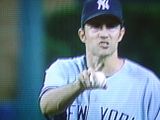
We love you for all your great performances. Your start in game 3 of the 2001 ALDS kept us alive in that series. Seven innings, four hits, one walk, and no runs. Your near perfect game made for an awesome Sunday night duel with David Cone. Your perfect tough lasted twenty six outs and two strikes.
Most of all, we revere you for your epic performance in game 7 of the 2003 ALCS. In the top of the fourth, you made your first career relief appearance. The score was 4-0 Boston with men on first and third and no outs. You struck out Jason Varitek and then got Damon to ground into an inning ending DP. You then threw two more scoreless innings, saving the game and the series for us.
We will miss you, Mr. Mussina and we wish you the best in the future.
Sincerely,
A big fan
P.S. One last time: MOOOOOOOOOOSSSSSSSSSSEEEEEE!!!

11/17/08
Horrible ballot
Proof
Quote:
Here's the way I voted:
1. Ryan Howard, Phil
2. CC Sabathia, Mil
3. Manny Ramirez, LA
4. Carlos Delgado, NY
5. Aramis Ramirez, Chi
6. Prince Fielder, Mil
7. Albert Pujols, Stl
8. Ryan Ludwick, Stl
9. Ryan Braun, Mil
10. David Wright, NY
This is a real ballot. This guy seriously voted. This guy seriously put Pujols 7th (!!!1!1!!!!111!), behind CC Sabathia (all 130.7 innings of him), Manny Ramirez (Even though he didn't even total 200 AB in the NL), Aramis Ramirez, Carlos Delgado, Prince Fielder, and Ryan Howard.
He must of filled out the ballot on the short bus.
Quote:
Here's the way I voted:
1. Ryan Howard, Phil
2. CC Sabathia, Mil
3. Manny Ramirez, LA
4. Carlos Delgado, NY
5. Aramis Ramirez, Chi
6. Prince Fielder, Mil
7. Albert Pujols, Stl
8. Ryan Ludwick, Stl
9. Ryan Braun, Mil
10. David Wright, NY
This is a real ballot. This guy seriously voted. This guy seriously put Pujols 7th (!!!1!1!!!!111!), behind CC Sabathia (all 130.7 innings of him), Manny Ramirez (Even though he didn't even total 200 AB in the NL), Aramis Ramirez, Carlos Delgado, Prince Fielder, and Ryan Howard.
He must of filled out the ballot on the short bus.
Worst mailbag ever
Which comes courtesy of the Yankees homepage on mlb.com
Question:
The Yankees say they want pitching, so why not get Mark Prior? He's only 28, and a healthy Prior is a Cy Young contender.
-- Mandeep S., Jamaica, N.Y.
Um, whoa, "Mandeep" from Jamaica, NY. Prior hasn't been healthy since 2005 and didn't throw a single Major League pitch in 2007 and 2008. Yet, no worries, he'll still be in Cy Young shape.
Question:
If Jorge Posada goes down again to injury, could they use Jesus Montero as a backup?
-- Kenny S., Greece, N.Y.
Okay, I should cut some people some slack since most don't follow the Minors, but this is a literally retarded question. Montero isn't even 20 and has yet to play a game in high A, yet this person is ready to pencil him as Posada's 2009 backup- even though Jose Molina, defensive wizard, is under contract for 2009. Just the fact he knows who Montero is and what position he plays means he knows something, so I will show no mercy in this dojo. Kenny, you sir, are a disgrace to baseball intellectuality.
Question:
The Yankees say they want pitching, so why not get Mark Prior? He's only 28, and a healthy Prior is a Cy Young contender.
-- Mandeep S., Jamaica, N.Y.
Um, whoa, "Mandeep" from Jamaica, NY. Prior hasn't been healthy since 2005 and didn't throw a single Major League pitch in 2007 and 2008. Yet, no worries, he'll still be in Cy Young shape.
Question:
If Jorge Posada goes down again to injury, could they use Jesus Montero as a backup?
-- Kenny S., Greece, N.Y.
Okay, I should cut some people some slack since most don't follow the Minors, but this is a literally retarded question. Montero isn't even 20 and has yet to play a game in high A, yet this person is ready to pencil him as Posada's 2009 backup- even though Jose Molina, defensive wizard, is under contract for 2009. Just the fact he knows who Montero is and what position he plays means he knows something, so I will show no mercy in this dojo. Kenny, you sir, are a disgrace to baseball intellectuality.
11/13/08
Trade
Today, the Yankees traded Wilson Betemit, Jeff Marquez, and Jhonny Nunez for Nick Swisher and Kanekoa Teixeira.
What a steal for the Yanks. They gave up three players going pretty much nowhere, for a solid bat who can play all three OF spots and 1b. In over 2000 career AB's he has a 112 OPS+ and early Marcel projections had him achieving a wOBA above .350 (projected for Chicago). Hopefully this doesn't keep the Yanks from looking into Teixeira, but either way its still a great trade.
Swisher was pretty unlucky last year as well:
'07: LD: 20% GB: 38% K: 19.9% BB: 15.2% ISOP: .193 BABIP: .308
'08: LD: 19% GB: 35% K: 22.8% BB: 14.0% ISOP: .191 BABIP: .251
And here are Swisher's contractual obligations for his age 28-31 seasons from Cot's:
09:$5.3M, 10:$6.75M, 11:$9M 12:$10.25M club option ($1M buyout)
* 2012 option increases to $12M with top 5 in MVP vote any year 2007-11
Teixeira ain't so bad himself.
What a steal for the Yanks. They gave up three players going pretty much nowhere, for a solid bat who can play all three OF spots and 1b. In over 2000 career AB's he has a 112 OPS+ and early Marcel projections had him achieving a wOBA above .350 (projected for Chicago). Hopefully this doesn't keep the Yanks from looking into Teixeira, but either way its still a great trade.
Swisher was pretty unlucky last year as well:
'07: LD: 20% GB: 38% K: 19.9% BB: 15.2% ISOP: .193 BABIP: .308
'08: LD: 19% GB: 35% K: 22.8% BB: 14.0% ISOP: .191 BABIP: .251
And here are Swisher's contractual obligations for his age 28-31 seasons from Cot's:
09:$5.3M, 10:$6.75M, 11:$9M 12:$10.25M club option ($1M buyout)
* 2012 option increases to $12M with top 5 in MVP vote any year 2007-11
Teixeira ain't so bad himself.
11/10/08
Jeremy Bleich
In the Hawaiian League:
30.2 iIP, 7 ER, 24 H, 1 HR, 9 BB, 31 K. 1.36 GO/AO
And in his last four starts:
24.2 IP, 28 K, 1 BB
Yeah.
30.2 iIP, 7 ER, 24 H, 1 HR, 9 BB, 31 K. 1.36 GO/AO
And in his last four starts:
24.2 IP, 28 K, 1 BB
Yeah.
John Manuel taken to school
By another anonymous forum poster:
Career MLB totals - % of fastballs thrown
Slowey - 66%
Hughes - 64.9%
Chamberlain - 64.8%%
Blackburn - 49.4%
Ah, gotta love writers with a broad audience who do zero research.
| john manuel wrote: |
| I know the Twins throw more fastballs with those two guys [Nick Blackburn and Kevin Slowey] in particular being fastball guys, whereas Hughes and Joba both have plus breaking balls. |
Career MLB totals - % of fastballs thrown
Slowey - 66%
Hughes - 64.9%
Chamberlain - 64.8%%
Blackburn - 49.4%
Ah, gotta love writers with a broad audience who do zero research.
Subscribe to:
Posts (Atom)


