After the Yankees recent and reasonable contracts handed out to CC Sabathia and AJ Burnett, the media and fans have exploded with disgust. The big argument is that the Yankees are stupidly spending this money on pitchers and overpaying. This is false and I presume people do not know that, since they do not know how to value free agents.
Currently, there is a stat that does just that- WAR. WAR literally stands for Wins Above Replacement. A Replacement player is your typical AAA/AAAA player. A team of replacement players would easily set the record for most losses in a season. As Tangotiger wrote, WAR is, "he talent level for which you would pay the minimum salary on the open market, or for which you can obtain at minimal cost in a trade."
For positional players, the replacement level is set at -2.25 per 162 games, below the league average. However, since the AL is a tougher league than the NL, the AL replacement level is -2.5 and the NL replacement level is -2.
Along with league adjustments, there are positional adjustments. This is done to make sure an average defender at one position, lets say LF, is not equal to an average defensive SS. The adjustments are as follows:
+1.0 wins C
+0.5 SS/CF
+0.0 2B/3B
-0.5 LF/RF/PH
-1.0 1B
-1.5 DH
Starting pitchers and relievers have different baselines, since pitchers are expected to perform better out of the pen. The replacement level for starters is .380 win% and .470 win% for relievers. Again, there is a league adjustment; AL starters and relievers are .370% and .460% while NL starters and relievers are .390% and .480%. Closers have a replacement level of .570%. If a closer gets any wins above that level, it is multiplied by his Leverage Index.
The formula for calculating WAR for positional players takes into account league, position, PA, wOBA, and defense. The formula for starters and relievers includes ERA and IP. Right now, 1 WAR = $4.84 million. So a player with a 2 WAR on today's open market is worth about $10 million per year. The free agent value, this year $4.84 million, increases about 10% each season. Last year it was $4.4 million.
So lets test this out on some free agents or former free agents. First, we'll do Mark Teixeira. Marcel projects Teixeira to have a .386 wOBA. Subtract that from a projected league average- I am using .340. Use that answer (.46) and divide by 1.15. Times that answer by projected PA (in this case, 600). Now divide that by 10.5. Now add in 2.5 for the league adjustment, but subtract 1 for the positional adjustment. Adding in .84 for defense (Runs defensive metric/10.5) and Mark Teixeira's WAR is about 4.5. Multiply that by the free agent value of 4.84 and you will see Mark is worth about $22 million per year. An 8/176 deal is around fair price for him. (The .338 is whatever the league average wOBA is, which is EXACTLY equal to whatever the league average OBP is; 1.15 is the relationship between wOBA and runs; 700 is the number of PA per 162 games; 10.5 is the relationship between runs and wins- Tangotiger)
Now, lets do CC Sabathia. After plugging in projections on my WAR calculator (if you want one, just ask), Sabathia has about a 5.1 WAR. So he is worth about $25-$26 million on the open market and is worth an additional amount of money to the Yankees. They are paying him $23 million per year.
Finally, lets do AJ Burnett. After accounting for a risk of injury and not throwing 200 innings annually, his WAR is around 3.5. That makes him worth $16.94 per year. The Yankees are paying him fair value. If Burnett stays healthy and can pitch effectively for 200+ innings, the Yankees could even have a bargain on their hands. Of course, this and the CC contract can blow up on their faces because of injury.
If anyone wants an exact formula for batters, just ask me. And there- now you can tell if a team is spending too much on a player or not. You are welcome.
12/16/08


Marlins president bashes Yankees signing of CC Sabathia
While on a radio show, the president of the Marlins called in to complain that the actions taken by the Yankees in signing Sabathia are irresponsible and sets a bad precedent for future contracts.
1. Well, the Yankees were not irresponsible. CC Sabathia is worth about $25-$26 mil per year. The Yankees are paying him $23 mil per year. It should also not set a bad precedent for future contracts, unless teams plan on giving this much money to average players, not top players in all of baseball
2. He draws 500 people a night if he is lucky. Maybe if he invested money in his team, the attendance figures would rise, giving him a return on his payroll investment. But hey, he should be rejoicing because of the increased amount of revenue sharing he will receive because of the signing.
However, I see his point on why the Yanks are "irresponsible". Since the Yanks get a revenue sharing break from their new stadium, the Marlins president won't be able to buy his luxury yacht and summer house this season.
1. Well, the Yankees were not irresponsible. CC Sabathia is worth about $25-$26 mil per year. The Yankees are paying him $23 mil per year. It should also not set a bad precedent for future contracts, unless teams plan on giving this much money to average players, not top players in all of baseball
2. He draws 500 people a night if he is lucky. Maybe if he invested money in his team, the attendance figures would rise, giving him a return on his payroll investment. But hey, he should be rejoicing because of the increased amount of revenue sharing he will receive because of the signing.
However, I see his point on why the Yanks are "irresponsible". Since the Yanks get a revenue sharing break from their new stadium, the Marlins president won't be able to buy his luxury yacht and summer house this season.
Olney: Why are teams bidding for a free agent?
Bustner Olney writes why Baltimore and Washington should not be bidding for Mark Teixeira.
Read: Stop bidding so Boston can sign him.
Read: Stop bidding so Boston can sign him.
12/3/08
Will Peter Gammons Retire?
I am not even going to break down this quote. It's too awful to do so.
Gammons on the new Pedroia contract...
Quote:
That it got done this quickly shows how much Pedroia loves playing in Boston, and that he prefers playing to dickering over arbitration and free-agent dollars. His favorite phrase is "it's all about winning."
And he means it.
Just, wow.
Gammons on the new Pedroia contract...
Quote:
That it got done this quickly shows how much Pedroia loves playing in Boston, and that he prefers playing to dickering over arbitration and free-agent dollars. His favorite phrase is "it's all about winning."
And he means it.
Just, wow.
I like white Rice...
... but not black Rice.
Evans was a life long Red Sox right fielder, whose career just spanned three decades. His career from 1972-1991. Jim Rice played from 1974-1989, so Evans played during the same exact era as Rice, on the same team, on the same patch of outfield grass. Rice still has a shot to make the HOF in his fifteenth try. Evans was knocked off the voting in three seasons, never getting higher than 10.4% of the vote in any of those three years.
So my question is, if Evans barely made a dent in the voting for three years, why was Rice not kicked off the ballot in even shorter time? So lets look at the numbers (KEEP IN MIND I AM NOT ADVOCATING OR DENYING THAT EVANS SHOULD BE A HOF'er):
JR: 9058 PA- .298/.352/.502/.854/128+ with a .375 wOBA, .293 EqA, 1367 EqR, 80.2 WARP3
DE: 10569 PA- .272/.370/.470/.840/127+ with a .374 wOBA, .296 EqA, 1606 EqR, 116.5 WARP3
Hmmm, who was better? Near identical OPS+ and wOBA. But Evans has a better EqA even though he played longer past his prime and even though the disparity in PA is big, I doubt in the twilight of Rice's career, he would muster enough EqR and WARP3 to pass Evans. The WARP3 is really striking. 80.2 is bad for a HOF hitter. Just bad. Pitiful. Disgusting. In almost as many PA, Bernie Williams has a much higher WARP3.
And the rest is taken from a member of SOSH:
Always regarded as a good defensive outfielder, Evans topped 10 assists from right field five times in his career. Additionally, for his career he scored 277 runs above replacement as a right fielder and 85 runs above average against other right fielders. In stark contrast, while Rice was able to accumulate a great deal of assists over his career (likely aided by both his throwing arm and playing LF at Fenway), Rice was not able to score close to an average RAA over the course of his career (-51)....While I do not think Rice should be a member of the Hall of Fame (though he deserves much consideration), I do believe his teammate does. Evans was a much better fielder, almost an equal as a hitter and lasted much longer. While Jim Rice had a season that trumps any season of Evans (Rice’s 78 ranks with the best of seasons), Evans was a tremendous RF season after season, over three decades. He’s Boston’s Billy Williams.
He sums it up nicely. Rice is not a HOF'er and if any Red Sox alumnus deserves to be in the HOF, it is Dwight Evans and not Rice. End o' story.
And one thing real fast on Tim Raines and why he is a ROCK that deserves to be in the HOF. In the National League in the 1980s, the league slugging percentage once topped .400 (1987, .404) and often was .360-.370. As a result, the "break-even" point for stolen bases was a lot lower than the 75-80% it is today (somewhere around 62-65%, I think). Because so few players had extra base power, the ability to get yourself into scoring position without giving away an out was incredibly valuable. Stealing 60+ bases at an 86% clip (which was Raines success rate from 1981-1990, when he averaged 62.7 steals/year) provided a ton of value. That is just another point to prove Raines is a HOF player.
Evans was a life long Red Sox right fielder, whose career just spanned three decades. His career from 1972-1991. Jim Rice played from 1974-1989, so Evans played during the same exact era as Rice, on the same team, on the same patch of outfield grass. Rice still has a shot to make the HOF in his fifteenth try. Evans was knocked off the voting in three seasons, never getting higher than 10.4% of the vote in any of those three years.
So my question is, if Evans barely made a dent in the voting for three years, why was Rice not kicked off the ballot in even shorter time? So lets look at the numbers (KEEP IN MIND I AM NOT ADVOCATING OR DENYING THAT EVANS SHOULD BE A HOF'er):
JR: 9058 PA- .298/.352/.502/.854/128+ with a .375 wOBA, .293 EqA, 1367 EqR, 80.2 WARP3
DE: 10569 PA- .272/.370/.470/.840/127+ with a .374 wOBA, .296 EqA, 1606 EqR, 116.5 WARP3
Hmmm, who was better? Near identical OPS+ and wOBA. But Evans has a better EqA even though he played longer past his prime and even though the disparity in PA is big, I doubt in the twilight of Rice's career, he would muster enough EqR and WARP3 to pass Evans. The WARP3 is really striking. 80.2 is bad for a HOF hitter. Just bad. Pitiful. Disgusting. In almost as many PA, Bernie Williams has a much higher WARP3.
And the rest is taken from a member of SOSH:
Always regarded as a good defensive outfielder, Evans topped 10 assists from right field five times in his career. Additionally, for his career he scored 277 runs above replacement as a right fielder and 85 runs above average against other right fielders. In stark contrast, while Rice was able to accumulate a great deal of assists over his career (likely aided by both his throwing arm and playing LF at Fenway), Rice was not able to score close to an average RAA over the course of his career (-51)....While I do not think Rice should be a member of the Hall of Fame (though he deserves much consideration), I do believe his teammate does. Evans was a much better fielder, almost an equal as a hitter and lasted much longer. While Jim Rice had a season that trumps any season of Evans (Rice’s 78 ranks with the best of seasons), Evans was a tremendous RF season after season, over three decades. He’s Boston’s Billy Williams.
He sums it up nicely. Rice is not a HOF'er and if any Red Sox alumnus deserves to be in the HOF, it is Dwight Evans and not Rice. End o' story.
And one thing real fast on Tim Raines and why he is a ROCK that deserves to be in the HOF. In the National League in the 1980s, the league slugging percentage once topped .400 (1987, .404) and often was .360-.370. As a result, the "break-even" point for stolen bases was a lot lower than the 75-80% it is today (somewhere around 62-65%, I think). Because so few players had extra base power, the ability to get yourself into scoring position without giving away an out was incredibly valuable. Stealing 60+ bases at an 86% clip (which was Raines success rate from 1981-1990, when he averaged 62.7 steals/year) provided a ton of value. That is just another point to prove Raines is a HOF player.
11/24/08
Solving baseball's problems
If there is one thing most baseball fans can agree on, it’s their passionate hate for the New York Yankees. Why? Well, as one Phillies fan puts it, “they buy their way into championships”.
Large market teams such as the Yankees, Boston Red Sox, and Los Angeles Angels have the financial power to sign expensive free agents, over small market teams such as the Milwaukee Brewers. In fact, the Brewers contract offer of four years and $100 million to this year’s top free agent, CC Sabathia, was dwarfed by the Yankees offer of six years and $140 million.
The financial authority that large market teams have over small market teams is why baseball fans want a salary cap. A salary cap is simply a limit on how much a team can spend on their roster payroll. By implementing a cap, fans feel that a competitive balance will be restored to baseball since large markets teams will no longer be able to outspend small market teams on pricy free agents.
However, success is not directly tied to payroll. In 2008, of the teams with the ten highest payrolls, only five made the playoffs. In fact, the league’s three highest payroll teams did not even make even make the playoffs. The Tampa Bay Rays, the American League champions and World Series participant, had the second lowest payroll at just over $43 million. Competitive balance in baseball is fine and the belief that teams with money have a competitive advantage is a fallacy.
With a cap, small market teams would still not spend. Just because large market teams will be restricted, there will still be no incentive for the owners of small market teams to spend. Meanwhile, a cap would unfairly punish successful and organized franchises. Also, while large market teams can spend more money on their payroll, to be successful, they still need to spend it wisely. Spending money on just anybody is not smart business and can hurt teams. Before the 2007 season, the San Francisco Giants signed pitcher Barry Zito to a seven year and $126 million dollar contract, the largest ever for a pitcher at the time. Since then, Zito has been one of the worst starters in baseball and his contract has hurt the Giants.
Major League Baseball’s solution to the “problem” was revenue sharing. Under the current contract, all teams must pay out 31% of their local revenue and it is split evenly among all thirty teams. Also, MLB’s Central Fund is divided up among teams according to their revenue. In affect, revenue sharing is basically the transition of money from large market teams to small market teams.
The current revenue sharing system has its own problems. Again, owners of small market teams have no incentive to re-invest the money they receive from large market teams on their payroll. This is because if the team spends the money they receive to build a winning team, they will receive less money from revenue sharing. In 2006, the Rays collected more than $30 million in revenue sharing. However, their payroll was just $35 million. In most cases, the money of large market teams goes straight to the pockets of small market owners, which defeats the purpose of the system.
The best solution to revenue sharing comes from Michael Lewis, an assistant marketing professor at Olin Business School in Washington University. His solution takes into account team payrolls, winning percentage, attendance, and size of the local population. Depending on attendance, the amount of money a team receives from revenue sharing can go up or down. If a team’s attendance is around 70%, their revenue sharing will go up. If their attendance is below 50%, they won’t receive as much money.
This improved revenue sharing is the best way for baseball to allow small market teams to keep up with the financial strength of large market teams. If revenue sharing is tied into attendance, it will give franchises a reason to build a successful team, so more fans show up to games. If more fans show up, teams gate receipts, fan loyalty, and revenue sharing will go up. By forcing teams to construct winning teams, it will increase the competitiveness and health of the league.
Michael Lewis’s solution is a win-win. Teams get better, attendance goes up, and owners make more money. What’s not to like?
Large market teams such as the Yankees, Boston Red Sox, and Los Angeles Angels have the financial power to sign expensive free agents, over small market teams such as the Milwaukee Brewers. In fact, the Brewers contract offer of four years and $100 million to this year’s top free agent, CC Sabathia, was dwarfed by the Yankees offer of six years and $140 million.
The financial authority that large market teams have over small market teams is why baseball fans want a salary cap. A salary cap is simply a limit on how much a team can spend on their roster payroll. By implementing a cap, fans feel that a competitive balance will be restored to baseball since large markets teams will no longer be able to outspend small market teams on pricy free agents.
However, success is not directly tied to payroll. In 2008, of the teams with the ten highest payrolls, only five made the playoffs. In fact, the league’s three highest payroll teams did not even make even make the playoffs. The Tampa Bay Rays, the American League champions and World Series participant, had the second lowest payroll at just over $43 million. Competitive balance in baseball is fine and the belief that teams with money have a competitive advantage is a fallacy.
With a cap, small market teams would still not spend. Just because large market teams will be restricted, there will still be no incentive for the owners of small market teams to spend. Meanwhile, a cap would unfairly punish successful and organized franchises. Also, while large market teams can spend more money on their payroll, to be successful, they still need to spend it wisely. Spending money on just anybody is not smart business and can hurt teams. Before the 2007 season, the San Francisco Giants signed pitcher Barry Zito to a seven year and $126 million dollar contract, the largest ever for a pitcher at the time. Since then, Zito has been one of the worst starters in baseball and his contract has hurt the Giants.
Major League Baseball’s solution to the “problem” was revenue sharing. Under the current contract, all teams must pay out 31% of their local revenue and it is split evenly among all thirty teams. Also, MLB’s Central Fund is divided up among teams according to their revenue. In affect, revenue sharing is basically the transition of money from large market teams to small market teams.
The current revenue sharing system has its own problems. Again, owners of small market teams have no incentive to re-invest the money they receive from large market teams on their payroll. This is because if the team spends the money they receive to build a winning team, they will receive less money from revenue sharing. In 2006, the Rays collected more than $30 million in revenue sharing. However, their payroll was just $35 million. In most cases, the money of large market teams goes straight to the pockets of small market owners, which defeats the purpose of the system.
The best solution to revenue sharing comes from Michael Lewis, an assistant marketing professor at Olin Business School in Washington University. His solution takes into account team payrolls, winning percentage, attendance, and size of the local population. Depending on attendance, the amount of money a team receives from revenue sharing can go up or down. If a team’s attendance is around 70%, their revenue sharing will go up. If their attendance is below 50%, they won’t receive as much money.
This improved revenue sharing is the best way for baseball to allow small market teams to keep up with the financial strength of large market teams. If revenue sharing is tied into attendance, it will give franchises a reason to build a successful team, so more fans show up to games. If more fans show up, teams gate receipts, fan loyalty, and revenue sharing will go up. By forcing teams to construct winning teams, it will increase the competitiveness and health of the league.
Michael Lewis’s solution is a win-win. Teams get better, attendance goes up, and owners make more money. What’s not to like?
11/21/08
My farewell to Mike Mussina
Dear Mr. Mussina,
Your recent retirement brings an end to a brilliant eighteen year career. In those eighteen years, you made 536 starts, totaling 3562.2 innings. You've notched a 3.68 ERA, 3.57 FIP, 1.19 WHIP, 7.11 K/9, 1.98 BB/9, and 3.58 K/BB. Moreover, when comparing your stats to the league average and finding the difference, for your career you are:
-Second in Baserunners/9
-Tenth in ERA
-Third in K/BB
- Fourth in BB/9
Going further, you ranked in the top 10 in the AL in:
-Strikeouts ten times
-ERA ten times
-RSAA seven times (Runs Saved Against Average)
-Hits/9 nine times
-WHIP eleven times
-K/9 ten times
-BB/9 fourteen times
-K/BB fourteen times
So, Mr. Mussina, your resume is not lacking. You spent your entire career in the AL East, a time when the Jays won two World Series, Yankees won four World Series, Red Sox won two World Series, and the Rays appeared in one world series. Yet you still accumulated these stats.
But I am not writing to tell you that. I am writing to thank you. To thank you for all your shining moments in pinstripes and all the joy you brought to Oriole fans, Yankee fans, and baseball fans. For your entire career you were Mr. Almost. Almost won a World Series. Almost won Cy Young. Almost threw a perfect. Almost won 20 games- until 2008. It was a magical season, in which you were one of the few Yankee bright spots and you made the season more enjoyable, even when we were eliminated. In May after a putrid start against Baltimore, where you did not even survive the first, we thought you were done. It was time to give up. But you battled back. You proved us wrong. On a damp, September Sunday in Boston, you had us watching, even though we were eliminated from the playoffs. We watched because we wanted to see you finally achieve something. Not fall short. And you did it- you finally won that 20th game for the first time.
We love you for your personality. Your post game interviews were a must for any Yankee fan. Your candid dislike of Carl Pavano was great. And in 2006 when you ordered Joe Torre to sit back down on the bench so you could stay in the game, our love grew even deeper for you.

We love you for all your great performances. Your start in game 3 of the 2001 ALDS kept us alive in that series. Seven innings, four hits, one walk, and no runs. Your near perfect game made for an awesome Sunday night duel with David Cone. Your perfect tough lasted twenty six outs and two strikes.
Most of all, we revere you for your epic performance in game 7 of the 2003 ALCS. In the top of the fourth, you made your first career relief appearance. The score was 4-0 Boston with men on first and third and no outs. You struck out Jason Varitek and then got Damon to ground into an inning ending DP. You then threw two more scoreless innings, saving the game and the series for us.
We will miss you, Mr. Mussina and we wish you the best in the future.
Sincerely,
A big fan
P.S. One last time: MOOOOOOOOOOSSSSSSSSSSEEEEEE!!!

Your recent retirement brings an end to a brilliant eighteen year career. In those eighteen years, you made 536 starts, totaling 3562.2 innings. You've notched a 3.68 ERA, 3.57 FIP, 1.19 WHIP, 7.11 K/9, 1.98 BB/9, and 3.58 K/BB. Moreover, when comparing your stats to the league average and finding the difference, for your career you are:
-Second in Baserunners/9
-Tenth in ERA
-Third in K/BB
- Fourth in BB/9
Going further, you ranked in the top 10 in the AL in:
-Strikeouts ten times
-ERA ten times
-RSAA seven times (Runs Saved Against Average)
-Hits/9 nine times
-WHIP eleven times
-K/9 ten times
-BB/9 fourteen times
-K/BB fourteen times
So, Mr. Mussina, your resume is not lacking. You spent your entire career in the AL East, a time when the Jays won two World Series, Yankees won four World Series, Red Sox won two World Series, and the Rays appeared in one world series. Yet you still accumulated these stats.
But I am not writing to tell you that. I am writing to thank you. To thank you for all your shining moments in pinstripes and all the joy you brought to Oriole fans, Yankee fans, and baseball fans. For your entire career you were Mr. Almost. Almost won a World Series. Almost won Cy Young. Almost threw a perfect. Almost won 20 games- until 2008. It was a magical season, in which you were one of the few Yankee bright spots and you made the season more enjoyable, even when we were eliminated. In May after a putrid start against Baltimore, where you did not even survive the first, we thought you were done. It was time to give up. But you battled back. You proved us wrong. On a damp, September Sunday in Boston, you had us watching, even though we were eliminated from the playoffs. We watched because we wanted to see you finally achieve something. Not fall short. And you did it- you finally won that 20th game for the first time.
We love you for your personality. Your post game interviews were a must for any Yankee fan. Your candid dislike of Carl Pavano was great. And in 2006 when you ordered Joe Torre to sit back down on the bench so you could stay in the game, our love grew even deeper for you.
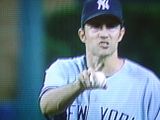
We love you for all your great performances. Your start in game 3 of the 2001 ALDS kept us alive in that series. Seven innings, four hits, one walk, and no runs. Your near perfect game made for an awesome Sunday night duel with David Cone. Your perfect tough lasted twenty six outs and two strikes.
Most of all, we revere you for your epic performance in game 7 of the 2003 ALCS. In the top of the fourth, you made your first career relief appearance. The score was 4-0 Boston with men on first and third and no outs. You struck out Jason Varitek and then got Damon to ground into an inning ending DP. You then threw two more scoreless innings, saving the game and the series for us.
We will miss you, Mr. Mussina and we wish you the best in the future.
Sincerely,
A big fan
P.S. One last time: MOOOOOOOOOOSSSSSSSSSSEEEEEE!!!

11/17/08
Horrible ballot
Proof
Quote:
Here's the way I voted:
1. Ryan Howard, Phil
2. CC Sabathia, Mil
3. Manny Ramirez, LA
4. Carlos Delgado, NY
5. Aramis Ramirez, Chi
6. Prince Fielder, Mil
7. Albert Pujols, Stl
8. Ryan Ludwick, Stl
9. Ryan Braun, Mil
10. David Wright, NY
This is a real ballot. This guy seriously voted. This guy seriously put Pujols 7th (!!!1!1!!!!111!), behind CC Sabathia (all 130.7 innings of him), Manny Ramirez (Even though he didn't even total 200 AB in the NL), Aramis Ramirez, Carlos Delgado, Prince Fielder, and Ryan Howard.
He must of filled out the ballot on the short bus.
Quote:
Here's the way I voted:
1. Ryan Howard, Phil
2. CC Sabathia, Mil
3. Manny Ramirez, LA
4. Carlos Delgado, NY
5. Aramis Ramirez, Chi
6. Prince Fielder, Mil
7. Albert Pujols, Stl
8. Ryan Ludwick, Stl
9. Ryan Braun, Mil
10. David Wright, NY
This is a real ballot. This guy seriously voted. This guy seriously put Pujols 7th (!!!1!1!!!!111!), behind CC Sabathia (all 130.7 innings of him), Manny Ramirez (Even though he didn't even total 200 AB in the NL), Aramis Ramirez, Carlos Delgado, Prince Fielder, and Ryan Howard.
He must of filled out the ballot on the short bus.
Worst mailbag ever
Which comes courtesy of the Yankees homepage on mlb.com
Question:
The Yankees say they want pitching, so why not get Mark Prior? He's only 28, and a healthy Prior is a Cy Young contender.
-- Mandeep S., Jamaica, N.Y.
Um, whoa, "Mandeep" from Jamaica, NY. Prior hasn't been healthy since 2005 and didn't throw a single Major League pitch in 2007 and 2008. Yet, no worries, he'll still be in Cy Young shape.
Question:
If Jorge Posada goes down again to injury, could they use Jesus Montero as a backup?
-- Kenny S., Greece, N.Y.
Okay, I should cut some people some slack since most don't follow the Minors, but this is a literally retarded question. Montero isn't even 20 and has yet to play a game in high A, yet this person is ready to pencil him as Posada's 2009 backup- even though Jose Molina, defensive wizard, is under contract for 2009. Just the fact he knows who Montero is and what position he plays means he knows something, so I will show no mercy in this dojo. Kenny, you sir, are a disgrace to baseball intellectuality.
Question:
The Yankees say they want pitching, so why not get Mark Prior? He's only 28, and a healthy Prior is a Cy Young contender.
-- Mandeep S., Jamaica, N.Y.
Um, whoa, "Mandeep" from Jamaica, NY. Prior hasn't been healthy since 2005 and didn't throw a single Major League pitch in 2007 and 2008. Yet, no worries, he'll still be in Cy Young shape.
Question:
If Jorge Posada goes down again to injury, could they use Jesus Montero as a backup?
-- Kenny S., Greece, N.Y.
Okay, I should cut some people some slack since most don't follow the Minors, but this is a literally retarded question. Montero isn't even 20 and has yet to play a game in high A, yet this person is ready to pencil him as Posada's 2009 backup- even though Jose Molina, defensive wizard, is under contract for 2009. Just the fact he knows who Montero is and what position he plays means he knows something, so I will show no mercy in this dojo. Kenny, you sir, are a disgrace to baseball intellectuality.
11/13/08
Trade
Today, the Yankees traded Wilson Betemit, Jeff Marquez, and Jhonny Nunez for Nick Swisher and Kanekoa Teixeira.
What a steal for the Yanks. They gave up three players going pretty much nowhere, for a solid bat who can play all three OF spots and 1b. In over 2000 career AB's he has a 112 OPS+ and early Marcel projections had him achieving a wOBA above .350 (projected for Chicago). Hopefully this doesn't keep the Yanks from looking into Teixeira, but either way its still a great trade.
Swisher was pretty unlucky last year as well:
'07: LD: 20% GB: 38% K: 19.9% BB: 15.2% ISOP: .193 BABIP: .308
'08: LD: 19% GB: 35% K: 22.8% BB: 14.0% ISOP: .191 BABIP: .251
And here are Swisher's contractual obligations for his age 28-31 seasons from Cot's:
09:$5.3M, 10:$6.75M, 11:$9M 12:$10.25M club option ($1M buyout)
* 2012 option increases to $12M with top 5 in MVP vote any year 2007-11
Teixeira ain't so bad himself.
What a steal for the Yanks. They gave up three players going pretty much nowhere, for a solid bat who can play all three OF spots and 1b. In over 2000 career AB's he has a 112 OPS+ and early Marcel projections had him achieving a wOBA above .350 (projected for Chicago). Hopefully this doesn't keep the Yanks from looking into Teixeira, but either way its still a great trade.
Swisher was pretty unlucky last year as well:
'07: LD: 20% GB: 38% K: 19.9% BB: 15.2% ISOP: .193 BABIP: .308
'08: LD: 19% GB: 35% K: 22.8% BB: 14.0% ISOP: .191 BABIP: .251
And here are Swisher's contractual obligations for his age 28-31 seasons from Cot's:
09:$5.3M, 10:$6.75M, 11:$9M 12:$10.25M club option ($1M buyout)
* 2012 option increases to $12M with top 5 in MVP vote any year 2007-11
Teixeira ain't so bad himself.
11/10/08
Jeremy Bleich
In the Hawaiian League:
30.2 iIP, 7 ER, 24 H, 1 HR, 9 BB, 31 K. 1.36 GO/AO
And in his last four starts:
24.2 IP, 28 K, 1 BB
Yeah.
30.2 iIP, 7 ER, 24 H, 1 HR, 9 BB, 31 K. 1.36 GO/AO
And in his last four starts:
24.2 IP, 28 K, 1 BB
Yeah.
John Manuel taken to school
By another anonymous forum poster:
Career MLB totals - % of fastballs thrown
Slowey - 66%
Hughes - 64.9%
Chamberlain - 64.8%%
Blackburn - 49.4%
Ah, gotta love writers with a broad audience who do zero research.
| john manuel wrote: |
| I know the Twins throw more fastballs with those two guys [Nick Blackburn and Kevin Slowey] in particular being fastball guys, whereas Hughes and Joba both have plus breaking balls. |
Career MLB totals - % of fastballs thrown
Slowey - 66%
Hughes - 64.9%
Chamberlain - 64.8%%
Blackburn - 49.4%
Ah, gotta love writers with a broad audience who do zero research.
BA: Top 10 Yankee prospects
Baseball America ranked the Yankees top 10 prospects after the 2008 season:
Overall, the list seems pretty weak. Melancon is a better talent than Coke or Aceves, and should be ranked that way. #4 for Romine seems generous and the same goes for Brackman at #3, even if his talent is worthy of that spot. McCallister should be higher than #6, after posting a 128 tRA+ in Charleston and a 130 tRA+ in Tampa. Not to mention he had an outstanding 5.48 K/BB ratio. And even though Suttle had a decent year in Charleston, he did so as a 23 year old.
Now, the Yankees system is still solid with several amazingly high ceiling players. But the BA top 10 isn't the most lavish top 10. That can be attributed to a couple graduates from the list, such as Joba Chamberlain and Ian Kennedy.
One complaint though about farm systems. So I will let an anonymous forum person sum up my thoughts:
| 1. Austin Jackson, of- Best Defensive Outfielder | |
| 2. Jesus Montero, c- Best Power Hitter | |
| 3. Andrew Brackman, rhp- Best Fastball | |
| 4. Austin Romine, c | |
| 5. Dellin Betances, rhp | |
| 6. Zach McAllister, rhp- Best Control | |
| 7. Alfredo Aceves, rhp | |
| 8. Phil Coke, lhp | |
| 9. Mark Melancon, rhp | |
| 10. Bradley Suttle, 3b- Best Hitter for Average |
Overall, the list seems pretty weak. Melancon is a better talent than Coke or Aceves, and should be ranked that way. #4 for Romine seems generous and the same goes for Brackman at #3, even if his talent is worthy of that spot. McCallister should be higher than #6, after posting a 128 tRA+ in Charleston and a 130 tRA+ in Tampa. Not to mention he had an outstanding 5.48 K/BB ratio. And even though Suttle had a decent year in Charleston, he did so as a 23 year old.
Now, the Yankees system is still solid with several amazingly high ceiling players. But the BA top 10 isn't the most lavish top 10. That can be attributed to a couple graduates from the list, such as Joba Chamberlain and Ian Kennedy.
One complaint though about farm systems. So I will let an anonymous forum person sum up my thoughts:
Also, take a look at the Red Sox’s top ten, whose farm system is supposedly leaps and bounds better than whatever the Yankees have to offer.
Nick Hagadone is number 3. He’s going to be 23 on the first day of 2009, and has pitched a grand total of 35 innings of professional baseball.
Daniel Bard, the man with a 99mph fastball and nothing else, is number 4.
And yet, the Red Sox are baseball’s model franchise and the Yankees are nothing but dirt beneath their feet.
AL Rookie of Year
Longoria - 140 (34.7 VORP)
Ramirez - 59 (20.7 VORP)
Ellsbury - 26 (17.8 VORP)
.....
Joba - 1 (32.3 VORP)
This is just one stat, but it goes to show how stupid the voters are. Until he was hurt, I would have had no problem giving the award to Joba. Even after the injury, he was still better than Ramirez and obviously way better than Chief Runs Fast. I mean, Ellsbury in third place is bad enough.
Ramirez - 59 (20.7 VORP)
Ellsbury - 26 (17.8 VORP)
.....
Joba - 1 (32.3 VORP)
This is just one stat, but it goes to show how stupid the voters are. Until he was hurt, I would have had no problem giving the award to Joba. Even after the injury, he was still better than Ramirez and obviously way better than Chief Runs Fast. I mean, Ellsbury in third place is bad enough.
11/4/08
Dumbing down America, by Wallace Matthews
You will not read a dumber article this winter.
Keeping Joba in the bullpen as Rivera's setup man is the way the Yankees can re-establish that kind of late-game dominance... That should be the Yankees' objective with Joba, turning him into Mo's understudy with the aim of becoming Mo's replacement. That will win them a lot more games than Ramirez's bat or his flaky personality.
Um, whoa. Wallace believes the Yanks don't need CC, Tex, Manny, or any other free agent. What they need is Joba to pitch 60 innings a season. I don't know what's worse-the fact that he is still harping on this or the fact that Joba was actually better as a starter than a reliever in 2008, and yet his solution is to put him in the pen.
Going off VORP, Manny was worth about 5 wins last season. Mariano, in arguably the best season of his career, was worth about 3.5 wins. So yeah, I'm sure making Joba face less batters over the course of a season will win more games than the bat of Manny or Teixeira.
From people like Matthews who want to dominate late innings, I ask: how are we going to get there? Yes, it's nice that our 8th and 9th inning guys are good pitchers. But what's the point if we are consistently losing? If Wallace was in charge, his rotation as of today is Wang and that's it. But since he doesn't want a free agent or Joba, we can pencil in Wang, Hughes, Aceves, Kennedy, whoever. That sounds like a winning rotation to me!
It's called shortening the game, and the Yankees used to do it better than anyone.
It's called stupidity, and Wallace Matthews does it better than anyone.
Keeping Joba in the bullpen as Rivera's setup man is the way the Yankees can re-establish that kind of late-game dominance... That should be the Yankees' objective with Joba, turning him into Mo's understudy with the aim of becoming Mo's replacement. That will win them a lot more games than Ramirez's bat or his flaky personality.
Um, whoa. Wallace believes the Yanks don't need CC, Tex, Manny, or any other free agent. What they need is Joba to pitch 60 innings a season. I don't know what's worse-the fact that he is still harping on this or the fact that Joba was actually better as a starter than a reliever in 2008, and yet his solution is to put him in the pen.
Going off VORP, Manny was worth about 5 wins last season. Mariano, in arguably the best season of his career, was worth about 3.5 wins. So yeah, I'm sure making Joba face less batters over the course of a season will win more games than the bat of Manny or Teixeira.
From people like Matthews who want to dominate late innings, I ask: how are we going to get there? Yes, it's nice that our 8th and 9th inning guys are good pitchers. But what's the point if we are consistently losing? If Wallace was in charge, his rotation as of today is Wang and that's it. But since he doesn't want a free agent or Joba, we can pencil in Wang, Hughes, Aceves, Kennedy, whoever. That sounds like a winning rotation to me!
It's called shortening the game, and the Yankees used to do it better than anyone.
It's called stupidity, and Wallace Matthews does it better than anyone.
LA Dodgers: Trying to miss the playoffs
Quote: According to ESPN's Peter Gammons, some Dodger officials have spread the word that Russell Martin will either be traded or moved to third base.
Between Colletti, McCourt, and Torre, I feel bad for Dodgers. The Dodgers want to move him because of a perceived attitude problem and a down year.
1. This is from the team that signed Kent and traded for Manny
2. Martin is a 25 year old, cost-controlled catcher who in the past three seasons has put up a wOBA* of .349, .370, and .353 with above average defense. Martin was 5th among MLB catchers in 2008 wOBA*. I guess those numbers, coming from a young catcher, are just not good enough for Colletti.
The thing is, it seems as if the Dodgers have really soured on him. I know the Yanks are not linked to him in a trade and I doubt they show interest, but if I was Cashman, I'd be on the phone with LA right now.
Between Colletti, McCourt, and Torre, I feel bad for Dodgers. The Dodgers want to move him because of a perceived attitude problem and a down year.
1. This is from the team that signed Kent and traded for Manny
2. Martin is a 25 year old, cost-controlled catcher who in the past three seasons has put up a wOBA* of .349, .370, and .353 with above average defense. Martin was 5th among MLB catchers in 2008 wOBA*. I guess those numbers, coming from a young catcher, are just not good enough for Colletti.
The thing is, it seems as if the Dodgers have really soured on him. I know the Yanks are not linked to him in a trade and I doubt they show interest, but if I was Cashman, I'd be on the phone with LA right now.
11/3/08
Cameron, Marte, Mitre
- Mike Cameron's option was exercised by the Brewers today. This is bad news for the Yanks, who could have signed Cameron to one a year deal as an effective stop gap until Austin Jackson is ready in 2010.
- It looks like the Yankees are going to decline Marte's option. I am against this. By picking up his option, they would have an effective reliever for 2009 and take his picks after he walks then. Or, sign and trade Marte, where he could bring in a return more significant than draft picks.
- Today, the Yankees inked Sergio Mitre to a one year deal worth $1.25 mil with an option for 2010.
He is currently rehabbing from TJS and won't be ready to pitch in live games until July or August of 2009. Previously, Mitre pitched for the Cubs and Marlins, and even pitched for Joe Girardi in 2006.
Over the course of 310.7 innings spread over five seasons (78 G and 52 GS), Mitre has a 5.36 ERA, 81 ERA+, 1.545 WHIP, and 1.74 K/BB. Not so hot, right? Well, Sergio Mitre could turn out to be a good signing for the New York Yankees. To prove this, lets look deeper into the numbers posted by Mitre from 2004-2007.
2004: 47 IP, 4.44 tRA, 108 tRA+, 2.2 pRAA
2005: 43.3 IP, 4.16 tRA, 109 tRA+, 2.1 pRAA
2006: 35 IP, 5.78 tRA, 86 tRA+, -2.8 pRAA
2007: 149 IP, 4.78 tRA, 104 tRA+, 3.6 pRAA
Outside 2006, Mitre has proven he can be an average starting pitcher, albeit in a small sample for a duration of five seasons. Along with this, Mitre has had some bad luck. His O-xO has been negative in every season and his xR-R has been negative in every season but run. Both suggest he has been plagued by bad defense or a bad park. In Chicago he pitched in a hitter friendly park and in Florida, he pitched in about a neutral park. A look at Team Defense Efficiency can confirm if he did in fact suffer from bad defenses. However, since he only passed 100 innings in a season during 2007, that is the only season will look at.
2007: .661 (29/30)
Ouch. That is bad. That horrendous TDE affirms the fact that Mitre's defense dependent stats suffered from a bad Marlin's defense.
Now, not only does Mitre appear to be an average or serviceable pitcher, but he is also an appealing pitcher. Why? Because he is an extreme GB pitcher. Here are his numbers from 2004-2007.
2004: 59.4 GB%, 2.38 GB/FB
2005: 65.8 GB%, 2.96 GB/FB
2006: 51.9 GB%, 1.86 GB/FB
2007: 59.7 GB%, 2.61 GB/FB
Total: 60.1 GB%, 2.53 GB/FB
That is very good. If Mitre can get ground balls at this rate, with a Yankee infield helping him out, then Mitre could be a bargain.
This is one of those low risk, high reward type moves that all GM's should be looking for. The main complaint is that the Yankees are giving this guy $1.25 mil when he won't even be ready to pitch until July. However, it is only paid if he reaches the majors. If he reaches the majors, then that means he has been good enough to earn it. Plus, it is prorated so if he joins the club mid-season, they owe him 500k. Mitre does have a ton of potential and upside, so its worth signing him should he somehow realize it. If he doesn't work out, then no money or roster spot is wasted.
Mitre's upside is related not only to a nasty sinker, but a great minor league resume. In 589.2 minor league innings, he has a 3.16 ERA, 1.25 WHIP, and 3.03 K/BB.
An idea with Mitre, besides providing pitching depth with upside, is to make him a productive reliever. As a reliever, his K rates have been up. So considering the surgery and his prior "failures" as a starter, turning him into a reliever could be a good idea.
For 2009, I have a projection for Mitre of 30 IP between August and September, with a 5.00 ERA. That gives him a WAR of 0.23, and thus his value would be about $1.41 mil. Considering the Yanks probably won't even pay him $1 mil, this could be a steal.
Now, I am not trying to make Mitre sound like the savior. But it is just an example that low
risk high reward deals are the small, unnoticed deals can be good bargains for professional
teams.
risk high reward deals are the small, unnoticed deals can be good bargains for professional
teams.
10/29/08
It's a shame no one is watching...
...because this shaped up to be the best series since 2002 (and it only went 5 games).
Once again Madden waits too long to throw Price and it costs him the game and the World Series.
Congrats to the Phillies.
And here's to the 2009 World Champs: the New York Yankees
Once again Madden waits too long to throw Price and it costs him the game and the World Series.
Congrats to the Phillies.
And here's to the 2009 World Champs: the New York Yankees
10/22/08
10/20/08
Yankees rumors
John Peretto:
Quote:
Perrotto expects a Jake Peavy deal to be done before the Winter Meetings, stating that the Braves, Yankees, and Dodgers seem to be the leaders in the race right now. He notes that the Yankees will be willing to include Phil Hughes, while the Braves are willing to move Yunel Escobar.
Quote:
The Yankees are planning on using Joba Chamberlain in their rotation next year, but are not planning on settling for what they have. Perrotto states that the Yankees will "go all-in" on the free agent market, making aggressive offers to C.C. Sabathia, A.J. Burnett, Derek Lowe, and Mark Teixeira.
Olney:
Quote:
The Yankees seem almost destined to sign Mark Teixeira this offseason, but while it's been suggested that Teixeira is seeking upwards of 10 years, $200MM, the Yankees may be looking to offer half of that, or "a deal in the range of 6 years, $18-20MM a year." Good news for the Orioles who look to be the biggest competitor for the Yankees in pursuing both Teixeira and A.J. Burnett.
The Yankees are gearing up to offer CC Sabathia "an offer that may dwarf those of other clubs, by a factor of 30 or 40 percent." Olney feels that may be a necessary surcharge to convince Sabathia to pitch in the Big Apple.
A rumor is a rumor, but it is good to see we are front runners for the top available players this off-season.
Also, congratulations to the Rays and Phillies on making the WS.
Quote:
Perrotto expects a Jake Peavy deal to be done before the Winter Meetings, stating that the Braves, Yankees, and Dodgers seem to be the leaders in the race right now. He notes that the Yankees will be willing to include Phil Hughes, while the Braves are willing to move Yunel Escobar.
Quote:
The Yankees are planning on using Joba Chamberlain in their rotation next year, but are not planning on settling for what they have. Perrotto states that the Yankees will "go all-in" on the free agent market, making aggressive offers to C.C. Sabathia, A.J. Burnett, Derek Lowe, and Mark Teixeira.
Olney:
Quote:
The Yankees seem almost destined to sign Mark Teixeira this offseason, but while it's been suggested that Teixeira is seeking upwards of 10 years, $200MM, the Yankees may be looking to offer half of that, or "a deal in the range of 6 years, $18-20MM a year." Good news for the Orioles who look to be the biggest competitor for the Yankees in pursuing both Teixeira and A.J. Burnett.
The Yankees are gearing up to offer CC Sabathia "an offer that may dwarf those of other clubs, by a factor of 30 or 40 percent." Olney feels that may be a necessary surcharge to convince Sabathia to pitch in the Big Apple.
A rumor is a rumor, but it is good to see we are front runners for the top available players this off-season.
Also, congratulations to the Rays and Phillies on making the WS.
Subscribe to:
Posts (Atom)


